
The ABB PM866A (3BSE076359R1) is a high-performance central processing unit designed for the AC 800M controller family within the ABB Ability System 800xA control platform. Featuring a 133 MHz 32-bit RISC processor and 64 MB of integrated RAM, it executes complex process control logic, batch management, and safety-critical algorithms with exceptional speed and deterministic cycle times.
Built for rail-mounted sub-rack integration, the PM866A supports native redundant processor configurations and features dual Ethernet ports alongside built-in CEX-Bus expansion interface channels. It delivers robust fault tolerance, continuous diagnostics, and hot-swap module replacement capability for critical industrial processing plants.
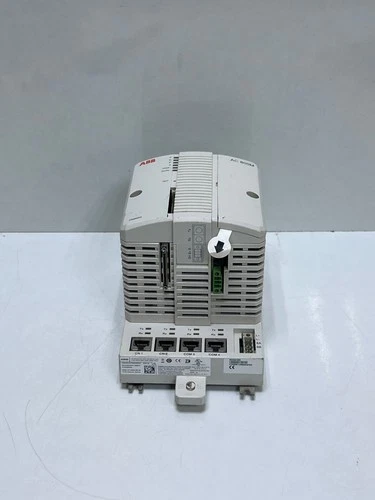
| Parameter Specification | Value / Feature Details |
| Brand | ABB |
| Model | PM866A (Ordering Code: 3BSE076359R1) |
| Series | AC 800M Hardware Series |
| Product Name | Controller Processor Unit |
| Country of Origin | Sweden |
| Product Status | Active / In Stock |
| Dimensions (H x W x D) | 185 mm x 119 mm x 135 mm |
| Weight | 1.10 kg (2.43 lbs) |
| Operating Voltage / Power | 24 V DC (19.2 to 30 V DC) / < 12 W |
| Operating Temperature | +5°C to +55°C (+41°F to +131°F) |
✔ Baseplate Installation: Snap the TP830 module termination baseplate securely onto the 35 mm DIN rail and ensure correct grounding continuity to the panel earth bar.
✔ Backplane & Bus Pin Check: Inspect the multi-pin CEX-Bus contacts and baseplate connectors for bent pins, dust, or contamination before mounting.
✔ Power Line Verification: Measure the dual 24 V DC power feeds with a digital multimeter to confirm voltage stability within the 19.2–30 V DC range.
✔ Module Seating: Align the PM866A processor unit carefully onto the TP830 baseplate guide channels and push firmly until top and bottom locking levers click into place.
✔ Network & Communication Setup: Connect redundant Ethernet cables to CN1/CN2 ports and verify link LED activity upon applying system auxiliary power.
◆ Enclosure Dust Control: Keep control panel cabinet filters clean and clear to maintain passive convection airflow across processor cooling fins.
◆ Terminal Block Tightness: Periodically check and re-torque screw terminals on the power feed baseplate to prevent vibration-induced loose connection faults.
◆ Battery Maintenance: Check internal real-time clock (RTC) backup battery status during scheduled maintenance turnarounds and replace as recommended.
◆ Project Application Backup: Maintain up-to-date backups of application program code, system parameters, and controller firmware using ABB Control Builder M software.
⚠ Processor Fault / Red System LED Active
Measure input power feeds at the baseplate terminals. Reseat the PM866A processor module in its baseplate slot to re-establish clean backplane pin contact.
⚠ Ethernet Communication Link Loss
Inspect RJ45 cables and network switch port links. Verify IP address assignments, subnet masks, and node settings in Control Builder M.
⚠ Application Run Error / Memory Fault
Re-commission the processor unit from the engineering workstation to reload project application software and parameter maps.
⚠ Disconnect Power Before Baseplate Wiring: Isolate 24 V DC auxiliary power sources before attaching or removing terminal connections on the module baseplate.
⚠ Electrostatic Discharge (ESD) Protection: Always wear a grounded anti-static wrist strap when handling the processor unit or accessing exposed bus connectors.
⚠ Hazardous Location Operation: Confirm system operating limits comply with Zone 2 / Class I Div 2 standards before operating in hazardous gas environments.
⚠ Redundant Hot-Swap Caution: In redundant processor setups, ensure the secondary processor has fully synchronized before attempting to pull or service the primary unit.
? Q: What is the main application of the ABB PM866A processor unit?
A: It serves as the primary CPU for AC 800M control systems, executing control loops, automation logic, and communication routing across System 800xA platform networks.
? Q: Does the PM866A support CPU redundancy?
A: Yes, two PM866A units can be mounted on a redundant baseplate (TP830) to form a high-availability primary/standby processor pair.
? Q: What software tool is used to program and configure the PM866A?
A: Programming, hardware configuration, and diagnostic monitoring are performed using ABB Control Builder M software.
? Q: Does the PM866A require internal batteries for configuration storage?
A: No, project configurations and application code are stored in non-volatile flash memory, while the battery is utilized solely to maintain the real-time clock during power outages.