
📌 Product Overview & Technical Datasheet
The ABB PM866A (Order Code: 3BSE076359R1) is a high-performance 133 MHz processor unit engineered for the ABB AC 800M automation system. Featuring 64 MB of RAM and built-in redundancy capabilities, it executes complex process control logic, sequence operations, and continuous closed-loop algorithms in System 800xA and Compact Control Builder environments.
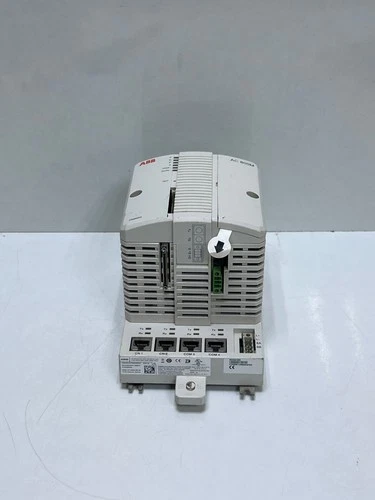
| Parameter | Specification |
| Brand | ABB |
| Model | PM866A / 3BSE076359R1 |
| Series | AC 800M Controller Series |
| Product Name | Controller Module Processor Unit / Programmable Controller |
| Country of Origin | Sweden |
| Product Status | Active / Available |
| Dimensions | 119 mm x 186 mm x 135 mm |
| Weight | Approx. 1.2 kg |
| Manufacturing Origin | Sweden |
| Power Consumption | 24 VDC nominal (19.2–30 VDC operating range, ~5.1 W typical / 8.6 W max) |
🚀 First-Time Commissioning Checklist
🔹 Inspect the anti-static packaging and module for physical damage before installation.
🔹 Mount the baseplate (such as TP830) securely onto a properly grounded DIN rail.
🔹 Verify that 24 VDC external power supplies meet the required operating limits before energizing.
🔹 Insert the 3.6 V lithium backup battery into the battery compartment to ensure RAM data retention.
🔹 Ensure required bus terminators are installed at both ends of the CEX-bus and ModuleBus racks.
🔹 Seat the PM866A processor module firmly onto its baseplate until the locking mechanism clicks into place.
🔹 Connect Ethernet cables to CN1/CN2 ports and establish communication using Control Builder software.
⚙️ Daily Maintenance Guidelines
🔹 Perform regular visual inspections to verify that status LEDs show normal RUN and power states.
🔹 Maintain cabinet temperatures within the operating range (+5°C to +55°C) to prevent thermal degradation.
🔹 Clean cabinet air filters periodically to maintain adequate ventilation across the CPU heatsink.
🔹 Check the internal lithium backup battery voltage according to schedule and replace when indicated.
🔹 Perform periodic application backups through Control Builder engineering tools to keep project files safe.
🛠️ Troubleshooting & Diagnostic Guide
🔹 Fault LED Active / Red: Access system event logs in Control Builder to analyze controller diagnostics and error codes.
🔹 Power LED Inactive: Check the 24 VDC power supply voltage, terminal block connections, and system distribution fuses.
🔹 Ethernet Loss (CN1/CN2): Inspect RJ45 cable connections, verify network switch port states, and check IP parameters.
🔹 Redundancy Synchronization Error: Check RCU-Link cable integrity, baseplate seating, and the status of the redundant partner CPU.
🔹 ModuleBus Communication Failure: Check ModuleBus cable terminations, expansion base contacts, and I/O cluster power supply rails.
⚠️ Safety Precautions
🔹 Power Isolation: Always switch off main supply power before inserting, removing, or wiring the controller module.
🔹 ESD Protection: Always wear a grounded anti-static wrist strap when handling the processor unit to protect sensitive circuitry.
🔹 Qualified Personnel: Installation, programming, and maintenance must only be carried out by qualified control engineers.
🔹 Cabinet Protection: Install the unit inside an IP54-rated industrial enclosure to guard against dust and moisture.
🔹 Bus Termination: Do not power up or operate the processor without proper bus terminators attached to the extension lines.
❓ Frequently Asked Questions (Q&A)
❓ What is the main function of the ABB PM866A processor unit?
It acts as the high-speed CPU processor in the ABB AC 800M controller family, running control programs and managing I/O and communication interfaces.
❓ Does the PM866A support CPU redundancy?
Yes, two PM866A modules can be installed as a redundant pair using RCU-Link interfaces for high-availability systems.
❓ What memory specification does the PM866A feature?
The unit features 64 MB of SDRAM memory (with application RAM around 51 MB) and 4 MB Flash PROM for system firmware.
❓ How is RAM memory retained during a power loss?
An onboard 3.6 V lithium backup battery preserves application program data and real-time clock settings when primary power is removed.