
The ABB SACO 16A3 is a versatile analog annunciator unit engineered for monitoring, supervision, and alarm indication in power plants, electrical substations, and industrial process facilities. Designed to process analog field signals (such as temperature, voltage, and current), this 16-channel unit converts analog measurements into clear visual and audible alarm indications. Featuring configurable alarm threshold levels, front panel LED indicators, a digital display screen, and serial communication support, the SACO 16A3 provides dependable plant safety monitoring and early fault detection.
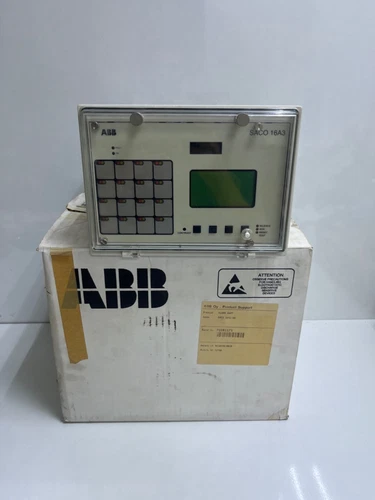
📋 Technical Datasheet & Specifications
| Parameter Name | Specification & Parameter Value |
| Brand | ABB |
| Model Number | SACO 16A3 |
| Product Series | SACO Annunciator Series |
| Product Name | Analog Annunciator Unit |
| Product Origin | Finland |
| Product Status | Active / Available |
| Physical Dimensions | 223 mm x 160 mm x 283 mm (19″ Rack Mounting Compatible) |
| Unit Weight | 3.20 kg (7.05 lbs) |
| Country of Manufacture | Finland |
| Auxiliary Supply Voltage | 80…265V AC/DC or 18…80V DC |
🚀 First-Time Commissioning Checklist
-
Unpack the unit carefully and visually inspect the front panel housing, display glass, and rear screw terminals for shipping damage.
-
Turn off primary power supplies and field instrument lines prior to inserting the unit into its panel cutout or rack chassis.
-
Wear a grounded anti-static wrist strap to avoid ESD damage when handling internal setting switches or wiring connectors.
-
Mount the unit securely into the panel opening and tighten all side retaining clamps to ensure solid earth contact.
-
Connect analog input channels (4-20mA, 0-10V, or RTD inputs) to their designated rear terminal blocks according to the wiring diagram.
-
Verify auxiliary power supply ratings and wire primary power and earth ground lines tightly.
-
Apply auxiliary power, calibrate baseline zero/span parameters, and test alarm threshold limits using a signal simulator.
🔧 Routine Maintenance & Care
-
Perform visual checks every six months to verify front panel LED status lights, display readability, and terminal tightness.
-
Clean the front membrane panel using a soft, dry anti-static cloth; do not use harsh chemical solvents or liquid sprays.
-
Ensure control panel ventilation pathways are clear to maintain ambient temperatures within recommended limits.
-
Check auxiliary relay contacts and communication cabling periodically to ensure tight, corrosion-free connections.
-
Maintain clean records of programmed channel setpoints, alarm hysteresis values, and calibration history.
🔍 Troubleshooting & Diagnostic Guide
-
Unit Will Not Power On (Power LED Off): Check auxiliary supply voltage at the rear terminals and inspect internal input fuses.
-
Incorrect Input Measurement Displayed: Verify analog signal transmitter output with a calibrated multimeter and re-check input channel scaling settings.
-
Alarm Relay Fails to Actuate: Check programmed high/low threshold setpoints, relay output logic, and delay timer configurations in the menu.
-
Communication Fault (SPA-bus / Modbus): Verify serial communication wiring, check bus termination resistors, and confirm slave address settings.
-
Channel Fault LED Flashing: Inspect the associated field sensor for open-circuit, short-circuit, or out-of-range signal conditions.
⚠️ Safety Precautions & Operating Guidelines
-
Never connect or disconnect terminal wiring while auxiliary power or live field signals are applied.
-
Installation, parameter configuration, and maintenance must be performed only by qualified electrical automation technicians.
-
Ensure the metal casing of the unit is securely bonded to the protective earthing system before applying power.
-
Do not expose the annunciator unit to direct moisture, conductive dust, or excessive physical vibration.
❓ Frequently Asked Questions (Q&A)
Q: What type of signals can the ABB SACO 16A3 annunciator unit accept?
A: The SACO 16A3 processes analog input signals such as standard milliamp signals (0-20mA / 4-20mA), voltage inputs (0-10V), or direct temperature sensor signals depending on the input board configuration.
Q: How are alarm setpoints and delay times configured on this module?
A: Parameters can be configured directly using the front panel keypad and display menu or remotely via SPA-bus serial communication using ABB parameterization software.
Q: Can the SACO 16A3 be integrated into a SCADA or DCS network?
A: Yes, it features serial communication interfaces that allow event logs, real-time analog channel values, and alarm states to be transmitted to higher-level SCADA and DCS systems.